Why AI bookmark managers need source citations
An AI answer you cannot trace back to a saved source is just a confident guess. Why citations are the dividing line between a trustworthy AI bookmark manager and a fluent one.
On this page
AI bookmark managers are only useful when you can trace answers back to the saved source. A summary that feels fluent but cannot show its evidence is just another loose note — and when you are about to act on that answer, "feels right" is not a standard.
This page explains why citations are the dividing line in this category, how citation-grounded answers actually work, and how to evaluate any AI reading tool — including Sensefold — on this axis.
The problem: fluent answers without evidence
Every AI tool in the read-it-later space now offers some form of summarization or question-answering. The failure mode they share is well documented: language models produce confident, fluent text even when the underlying facts are wrong or missing. Researchers call it hallucination; in practice it means an answer that reads perfectly and cannot be checked.
For a general chatbot, that is an annoyance. For a personal library, it is disqualifying — because the entire point of saving articles, PDFs, and screenshots is that you expect to rely on them later. Three specific things break when answers lack citations:
- Auditability. You cannot tell whether the answer came from the article you saved, from the model's training data, or from nowhere.
- Recall trust. Once a library grows past a few hundred items, memory stops working. If you cannot verify which saved item supports an answer, you are back to re-searching the open web — the exact problem you were trying to solve.
- Reuse. Research material is only reusable if you can quote its origin. An uncited summary cannot go into a report, a decision doc, or a term paper.
How citation-grounded answers work
The mechanics matter, because "has AI" and "has citations" are very different engineering commitments.
A citation-grounded system works roughly like this:
- Ingest: every saved item — web page, PDF, photo, note — is parsed, OCR'd if needed, and split into retrievable chunks tied to the original item.
- Retrieve: when you ask a question, the system searches your library (keyword + semantic) and pulls the specific chunks that are relevant.
- Answer with receipts: the model composes an answer from those chunks only, and each claim links back to the saved item it came from. (The gold standard the category is moving toward — Sensefold included — is anchoring citations to the exact passage or video timestamp; today Sensefold cites at the item level.)
The output is falsifiable: tap the citation, read the source, decide for yourself. If the retrieval found nothing relevant, an honest system says so instead of improvising.
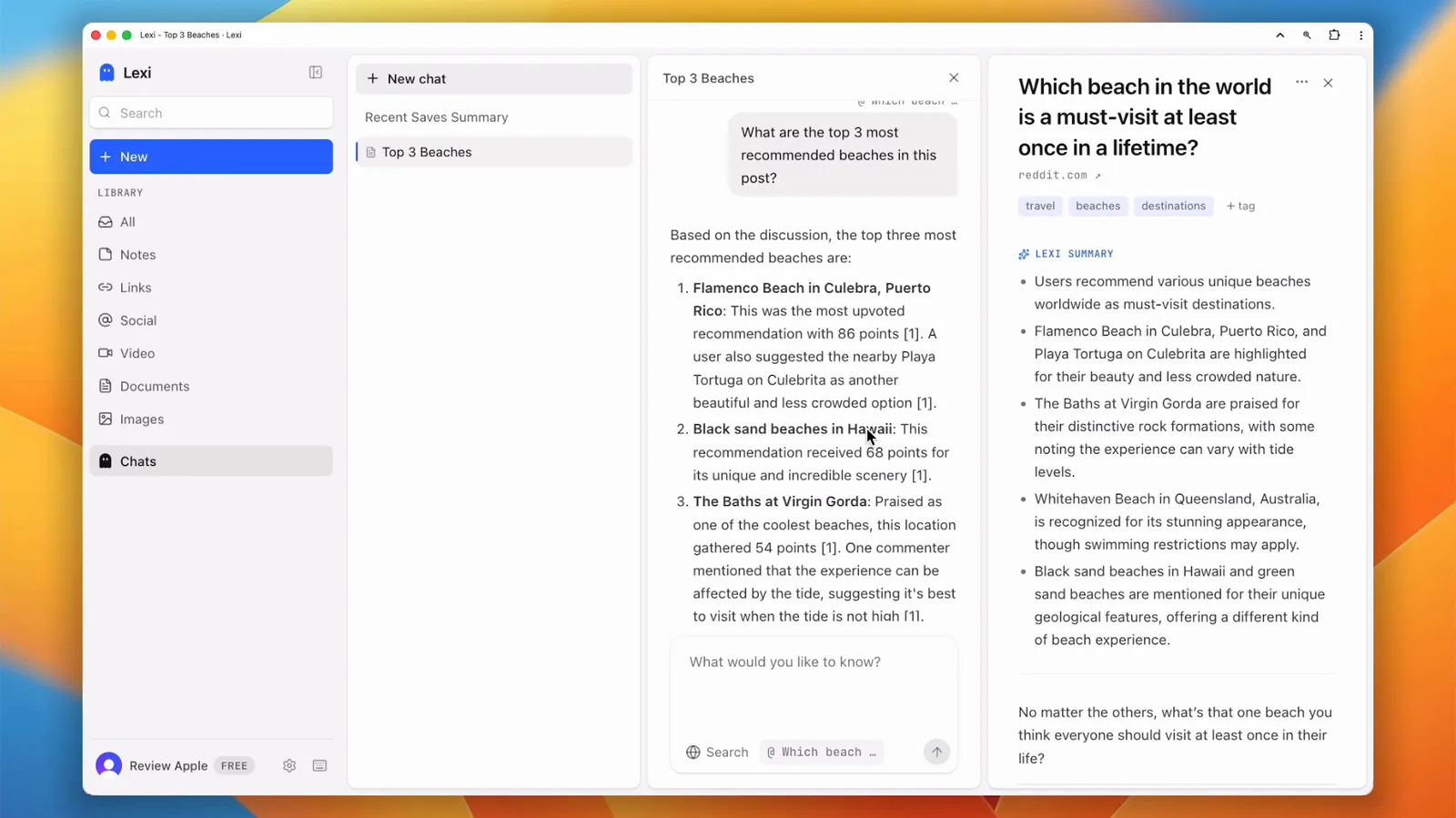
That is what it looks like in practice: the question, the numbered claims, and the saved item open beside the answer for verification.
This is why citations are hard to bolt on later. A tool that summarizes one open document at a time never needs a retrieval layer; a tool that answers across your whole library without one is guessing.
How the current tools compare
Where the major read-it-later and bookmark tools stand on this axis, based on their official product pages as of July 2026:
| Tool | AI answers | Cited to your saved sources? |
|---|---|---|
| Sensefold | Library-wide chat | Yes — every answer cites the saved items it drew from (item-level today; page- and timestamp-anchored citations are on the roadmap) |
| Readwise Reader | Ghostreader, per open document | Works inside one document, not across your library (readwise.io) |
| Matter | Co-Reader Q&A on the current article | Per-article, powered by Perplexity; no whole-library recall (getmatter.com) |
| Cubox | Ask AI across your library, on the Pro+AI plan ($69/yr) | Library-wide Q&A is gated to the top tier (cubox.cc) |
| Instapaper | Per-article summaries (10/month free; unlimited on Premium) | Summaries only, no cross-library question answering (Instapaper Summaries) |
| Raindrop.io | Stella AI assistant on Pro | Ask questions about saved content; this is distinct from automatic summaries (Raindrop.io Premium features) |
Two honest observations from that table. First, per-document AI (Ghostreader, Co-Reader, and Instapaper Summaries) is genuinely useful while you are reading — that is a different job than recalling across everything you saved, and tools can be good at one without the other. Second, Sensefold is not the only tool moving this direction; Cubox's Ask AI and Raindrop.io's Stella both answer questions about saved content. The differences are which tier includes the capability, how broadly it searches, and whether every answer carries its receipts.
For feature-by-feature breakdowns, see our comparison pages: Sensefold vs Readwise Reader, Sensefold vs Matter, and Sensefold vs Cubox.
What to check before trusting any AI bookmark manager
A quick evaluation checklist, applicable to any tool in this category:
- Ask a question you know the answer to — one whose source you saved last month. Does the answer cite that item?
- Click the citation. Does it land on the actual saved content, or just the item's title?
- Ask something your library does not contain. Does the tool admit it, or improvise an answer from thin air?
- Check the tier. Is citation-grounded answering included in the plan you will actually pay for, or reserved for the top tier?
- Test non-text content. Screenshots and PDFs are where most libraries silently lose information — does OCR'd content show up in answers, with the image cited?
The practical workflow
The loop that citations make possible:
- Capture the source while context is fresh — share sheet, drag-and-drop, paste.
- Let AI summarize, tag, and OCR it automatically, with the original attached.
- Ask questions later, and inspect the cited captures before trusting the answer.
That loop is what separates an AI bookmark manager from a generic read-it-later pile: the answer is a map back to your own evidence, not a replacement for it.
FAQ
Do AI citations eliminate hallucination? No. Retrieval grounding sharply reduces it and — more importantly — makes the remaining errors detectable, because you can check every claim against the cited source. Treat citations as a verification tool, not a guarantee.
Why do most AI reading apps skip citations? Because per-document summarization is much easier to build than library-wide retrieval. Citing sources across a mixed library of pages, PDFs, and images requires chunk-level indexing and OCR of everything at save time.
Does Sensefold cite sources on the free tier? Yes. Library-wide chat with citations is part of every Sensefold tier, including free. See how Sensefold works for the full capture–enrich–recall flow.